
BACTOLiVE® LEGUME
BACTOLiVE® LEGUME contain bacteria of the Rhizobiaceae that fix biologically air nitrogen in symbiosis with roots of legumes; the symbiosis is visible as root nodules. The product is either a peat based powder (of ca. 40% humidity) or a liquid. Different legume groups (see below) need specific species of the Rhizobiaceae. Thus, we offer 7 different products, each containing specific species of bacteria for a specific group of legumes:
- Rhizobium trifolium for clover
- Rhizobium leguminosarum for peas, broad beans (Vicia faba) and vetches
- Rhizobium leguminosarum for garden beans (Phaseolus beans)
- Mesorhizobium ciceri for chickpeas
- Sinorhizobium meliloti for alfalfa
- Bradyrhizobium japonicum for soya beans
- Bradyrhizobium lupini (syn. B. canariense) for lupins and serradella (Ornithopus)
The efficacy of the bacteria for N fixation can be very high, up to 200 kg N/ha and year. Thus, this is a very low cost biological method of nitrogen supply to the legume itself and to the follow crop.

Vicia faba with root nodules
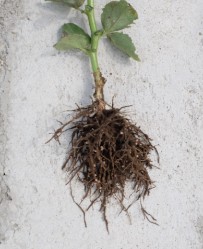
Soya beans with root nodules
Specific Rhizobia strains form a symbiosis with roots of specific legume groups. The symbiosis is visible as root nodules. Left photo: Nodules in roots of Vicia faba formed by Rhizobium leguminosarum. Right photo: root nodules in soya beans formed by Bradyrhizobium japonicum. Note that in the right photo, the inoculum was applied after germination as a liquid on the right side of the plant, and only there thenodules wer formed.
- BACTOLiVE® LEGUME products contain > 1.5 x 10⁹ bacteria per g or ml. The products are stable for a minimum of 2 years at ambient conditions (5 - 25° C).
- BACTOLiVE® LEGUME products are available in powder and liquid formulations
- Powder formulation is on peat base and in a 400 g bag (the formulation contains about 40% humidity)
- Liquid formulation is in 240 ml/ha sacchets or 5 L container (on request)
The powder formulation is usually applied at 400 g/ha, when the field is first time planted with legumes, 600 g/ha are used. To 400 g inoculum about 0.75 L of water is added and a slurry is produced. This is added to the amount of legume seed per one hectare, and evenly mixed with the seed so that the seed is homogenously covered with peat particles. Adapt the amount of water depending on seed size and amount if necessary so that good sticking is obtained. Bacteria in peat powder formulations resist survive better than in liquid formulations.
The liquid formulation is also mixed with about 0.75 L of water and the added to the seed of one hectare (again adapt amount of water depending on seed size and seed amount per ha). Then the materials are homogenously mixed. Liquid inocula are usually applied to fields where in the past the legume species was grown already, and where is is paossible that some native Rhizobia are available in unknown concentrations.
Always care to work in the shade because Rhizobia bacteria are sensitive to sunlight and drought. Plant seed at same day of treatment. The establishment of the legume-Rhizobium symbiosis reacts sensitive to mineral nitrogen fertilization at planting; in poor soils add only max 20 kg N/ha as a starter fertilization; in fertile soil do not add nitrogen fertilizer at all. Effective symbiosis needs some phosphate (in fertile soils P is biologically provided by arbuscular mycorrhiza) and specific micro-nutrients (Mo, Co, Fe) are essential.
It is strongly recommended to apply full dose (400 g/ha) of Rhizobium inoculum
- in soils that were not cultivated with the specific legume during 10 years or where soil cultivation history is unknown
- in sandy soils and sandy loams with low organic matter
- in soils with low nitrogen concentration at planting (and in soils with low N mineralization)
Apply half dose rate Rhizobium inoculum (200 g/ha powder, or liquid inoculum at 240 ml/ha) in all other conditions to make sure early and even nodule formation in legume roots, and thus optimum nitrogen fixation